
A brand new home for unemployed immigrants while Kiwis rot on the waiting list
Over the weekend, AppleBear on X shared an RNZ story meant to showcase compassion in action. Instead, it ended up highlighting exactly why so many New Zealanders see the system as completely broken.
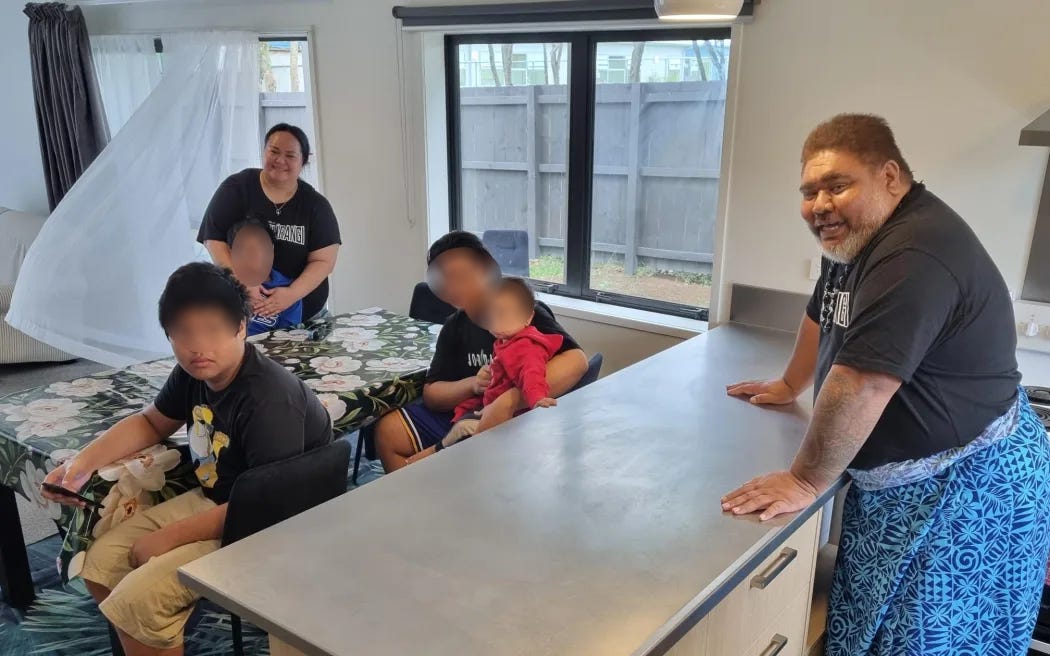
The article tells the story of the Tuiletufuga family, who “moved here from Samoa a year ago”, struggled to find housing, and for a period “lived in a van” before entering transitional accommodation. Now, after working with the Salvation Army, they have moved into a “new four-bedroom home” in Flat Bush, settling in just three weeks ago.
Taken in isolation, it sounds heartwarming. A family in need gets stability, space for their children, and the chance to rebuild. Nobody with a functioning conscience would begrudge any family the relief of having a roof over their heads. The anger comes from the wider context RNZ mentions only in passing but never truly confronts. Buried in the story is the fact that “there were 19,500 people waiting for state housing”. Nearly twenty thousand whūkn’ people already in the queue, many of them born here, many working here, many paying taxes here, still waiting.
That single number turns the whole story from uplifting to infuriating. Because while politicians and charities celebrate new builds and ribbon cuttings, Kiwi families remain stuck in cars, garages, overcrowded flats and emergency motels. Parents are still explaining to their kids why they cannot have their own room, or sometimes even their own bed. Workers are still handing over huge chunks of their pay just to keep a rental they are terrified of losing. For those people, reading about a family who arrived only last year moving into a brand new four-bedroom home does not feel like compassion in action. It feels like being told to stand back while someone else walks straight past them in the line.
The article notes that Jonathan Tuiletufuga said “it had been hard to find work and he had gone back to school to get qualifications”. That may well be a responsible step for him personally, but it also underlines the bigger question nobody in the story wants to address.
Why is New Zealand importing people who will immediately require housing assistance, income support, and other publicly funded services - right when the country is already struggling to house its existing residents? Why are we effectively paying newcomers to sit idle in their lava lava’s, watching TV while eating canned corned beef all day?
Why were we importing a family of six into New Zealand in the first place when the country was already deep in a housing shortage and social services were stretched to breaking point? Migration is supposed to strengthen the country, not immediately load more pressure onto systems that cannot cope. Six people means housing support, schooling, healthcare, transport subsidies, and income assistance, all before a single extra dollar flows into the tax base. Even a conservative estimate would put that support at thousands per week once accommodation, services and indirect costs are counted. Multiply that across similar cases and it is not hard to see why the waiting list keeps growing while the bill for taxpayers keeps climbing. Compassion without limits is not policy, it is a whūkn’ open cheque, and ordinary New Zealanders are the ones being asked to sign it.
The Salvation Army administers the housing, but the ecosystem that makes it possible is ultimately sustained by public funding, public infrastructure and public tolerance. Every new placement sits within a wider housing shortage that the government itself acknowledges. Yet at the opening of this development, even Christopher Luxon was present, speaking about backing community housing providers and building more homes. The rhetoric is always about doing more, building more and helping more, while the waiting list keeps swelling and the competition for scarce housing gets tighter.
This is where the whūkn’ frustration boils over for a lot of ordinary people. A country that cannot house its own citizens promptly should not be expanding demand faster than supply. A government that knows tens of thousands are waiting should be laser-focused on clearing that backlog before celebrating stories that highlight exactly how stretched the system is. Compassion that ignores practical limits stops looking like kindness and starts looking like reckless mismanagement.
None of this means the Tuiletufuga family did anything wrong. They did what any family would do in their position. The real issue is a system that keeps making decisions which leave long-time residents feeling like strangers in their own housing market. When New Zealanders see newcomers settling into stable homes while they remain stuck in limbo, it chips away at trust in the fairness of the system. Once that trust is gone, no number of human-interest stories will restore it.
If the country wants to maintain public support for migration, social housing and community programmes, the principle has to be simple and visible. House the people already here first. Reduce the waiting list to something manageable. Show that the system works for the citizens who fund it. Until that happens, stories like this will not read as inspiring examples of help in action. They will read as proof that the priorities are backwards, and that for thousands of New Zealanders still waiting, the queue only seems to move when someone else steps into the front of it.
The worst thing is that we’re bloody paying for it.


