


Firstly, I am sorry to hear that someone lost their life while walking the Taranaki Falls Track. My thoughts are with their family and loved ones. A sudden death on a popular walking track is tragic, and it deserves compassion, dignity, and respect.
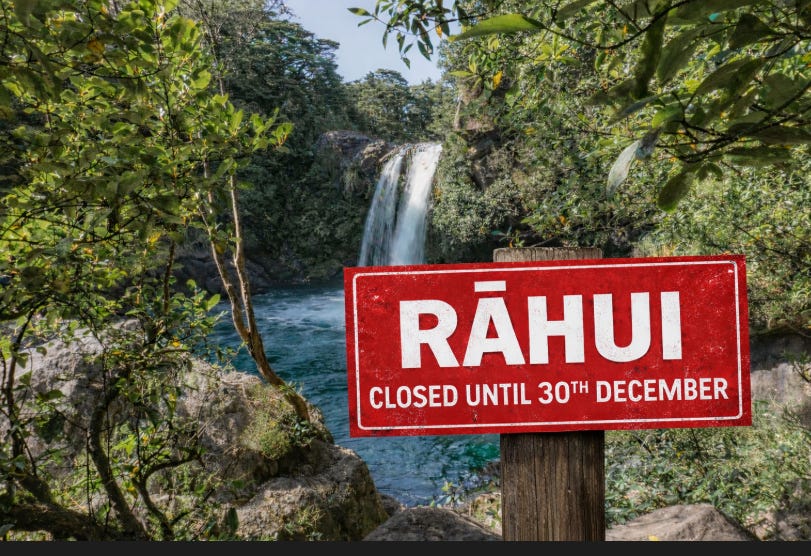
However, it needs to be said. Why on earth is a rāhui needed when someone passes away from natural causes?
Police have confirmed that a man became unresponsive while walking the Taranaki Falls Track, and that a rāhui was subsequently placed over parts of Tongariro National Park by the local hapū, Ngāti Hikairo ki Tongariro. The rāhui covers the Taranaki Falls Track and Tama Lakes tracks until 6am on Tuesday, December 30.
This is where the entire justification for rāhui falls apart.
Supporters often argue that rāhui imposed after drownings are about cleansing the sea, allowing fish and shellfish to recover in case they have consumed human remains. Whether you accept that explanation or not, it at least follows a kind of internal logic tied to water and food gathering.
But a sudden medical event on a walking track? That argument completely collapses. There is no environmental impact. There is no contamination risk. There is no practical reason to close public land. The only thing left is symbolism.
Which raises an uncomfortable question. Why does Ngāti Hikairo ki Tongariro believe it has the authority to restrict access to public land simply because someone died there?
If death alone is now the threshold for closure, where does it stop?
Where is the rāhui when a baby is beaten to death?
Where was the rāhui in Ruatiti after a double homicide?
Where is the rāhui for Jason Poa, murdered in Hamilton on Thursday?
Some will respond by saying many of those crimes occurred on private land. Fine. But many violent deaths happen on public streets, parks, reserves, and playgrounds every year. We do not see local iwi or hapū moving to close entire suburbs or city blocks. The application of rāhui is selective, inconsistent, and impossible to defend on any coherent principle.

If rāhui were genuinely about death itself, New Zealand would be permanently shut.
Two climbers recently died on Aoraki / Mount Cook. Connor Scott McKenzie and Tanmay Shetankumar Bhati both lived in Australia. Their deaths were deeply sad, and my sympathy is with their families. However, there was no rāhui placed over Mount Cook. No symbolic closures. No assertion of authority. One has to ask why. And one has to ask where Ngāi Tahu stands on this, because apparently the rules change depending on who is asserting them and where.
That is the uncomfortable truth at the heart of this issue.
In cases like this, rāhui is not about safety, environmental protection, or respect for the deceased. It is about control. It is about asserting power over public space and reminding the public who is boss, even when that space is a national park held in trust for all New Zealanders.
If we start closing tracks for sudden cardiac arrests, people collapsing on footpaths, or natural deaths in public places, vast parts of the country will regularly be off limits. That is not cultural respect. That is whākn’ absurd!
