
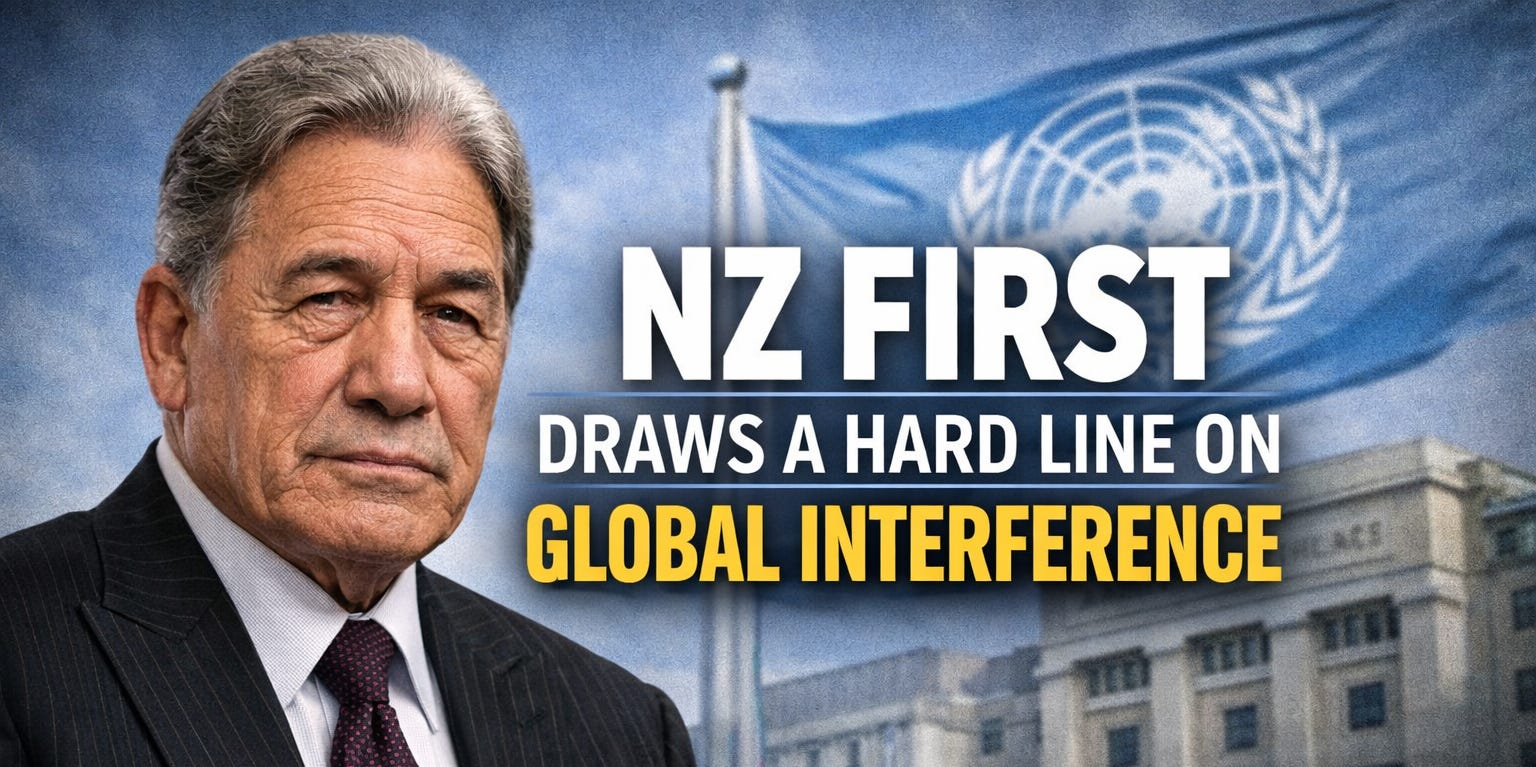
NZ First draws a hard line on global interference
When the Government formally notified the World Health Organisation that New Zealand would reject the proposed amendments to the International Health Regulations, it did more than tick a diplomatic box. It sent a clear signal about who governs this country.
For a long time, there has been a quiet but growing tension between national sovereignty and the expanding influence of international bodies. That tension came into sharp focus during and after Covid-19, when global coordination often blurred into expectation, and expectation into pressure. Decisions that affect the daily lives of New Zealanders began to feel increasingly shaped by consensus overseas rather than accountability at home.
That is why this move matters.
Winston Peters and New Zealand First have been consistent on one point: decisions about the health of Kiwis should be made in Wellington, not Geneva. You can agree or disagree with their broader politics, but on this issue, the principle is hard to argue against. Democratic accountability only works when the people making decisions can be held responsible by the voters who live with the consequences.
Supporters of the WHO amendments argue they are about coordination, preparedness and avoiding the chaos seen in past global health crises. That is a fair concern. No country operates in isolation, and pandemics do not respect borders. Cooperation matters.
But cooperation is not the same as control.
The amendments raised legitimate questions about how much authority could shift, in practice if not in theory, toward international institutions. Even the perception of that shift is enough to undermine public trust. New Zealanders expect their laws to be made by their elected representatives, not shaped indirectly through frameworks negotiated offshore.
This is where the coalition’s “National Interest Test” becomes more than just political branding. It reflects a growing public appetite for scrutiny. International agreements should not be waved through on the assumption they are inherently beneficial. They should be tested, openly and rigorously, against the simple question: does this serve New Zealand?
In this case, the answer from the Government was no.
Critics will label the decision as insular or reactionary. They will warn that stepping back from global frameworks risks leaving New Zealand isolated. That argument assumes that rejecting these amendments is the same as rejecting cooperation altogether. It is not. New Zealand remains part of the international community and can still engage, share information, and coordinate responses when it chooses to.
The difference is choice.
By rejecting the amendments, the Government has preserved its ability to decide how and when it acts, rather than being bound to evolving interpretations of international rules. That flexibility is not a weakness. It is the essence of sovereignty.
There is also a broader political reality at play. Around the world, voters are increasingly wary of decisions drifting away from national capitals into international institutions. Whether fairly or not, these bodies are often seen as distant, unaccountable and insulated from the everyday concerns of ordinary people. Ignoring that sentiment does not make it disappear.
New Zealand First has tapped into that mood and, in this instance, delivered on what it promised.
You do not have to buy into every line about “globalist bureaucrats” to recognise the underlying point. Sovereignty is not an abstract concept. It is about who has the final say when it matters most.
On this decision, that authority remains where it should be: with New Zealand, and with New Zealanders
.
Original email:
Dear Matua,
Today, New Zealand has informed the Director General of the World Health Organisation (WHO) via New Zealand’s Permanent Mission to the United Nations (UN) in Geneva, that in accordance with Article 61 of the International Health Regulations (IHR), New Zealand has officially rejected the proposed Amendments.
We know that this issue is important to New Zealanders and we fought on your behalf to ensure these IHR amendments were fully rejected.
“New Zealand First has always said that any decisions about the health of Kiwis should be made from Wellington, not Geneva.” – Rt Hon Winston Peters
New Zealand First made a promise to put the national interests of New Zealanders first, as we always have. Rejecting these amendments ensures that we maintain our sovereign decision making, and it pushes back on globalist bureaucrats.
In our coalition agreement we specifically included that we would ensure a ‘National Interest Test’ is undertaken before New Zealand accepts any agreements from the UN and its agencies that limit national decision-making. And that this would reconfirm our domestic law holds primacy over any international agreements.
So when we first got back into parliament late 2023, we immediately reserved against the proposed amendments to WHO health regulations while we considered these against our ‘National Interest Test’.
Matua, we kept our promise. And we have now officially rejected these amendments.
New Zealand First is the only Nationalist party.
We are defending our nation’s sovereignty.
We are putting New Zealand, and New Zealanders first.
We always have. We always will.


An excellent decision. It is well overdue for a conversation on being part of the United Nations. It is a failed organization on all fronts, run by representatives of a mix of corrupt socialist and communist countries from South America, Africa and Asia. They interfere behind the scenes on many topics including NZ internal issues, and are a dumping ground for entrepreneural socialists fresh from NZ Parliament. Why we pay moniey into this defunct sham needs addressing..